World Interventional & Dry Eye Society
The Society Behind Interventional Dry Eye
WIDES has pioneered Interventional Dry Eye as a new framework for dry eye care, one that connects disease mechanisms, objective diagnostics, and targeted therapeutic combinations in a more structured and clinically meaningful way.
A phenotype-driven approach to modern dry eye care

The Framework
The WIDES Approach
A structured, evidence-informed framework for the assessment and management of dry eye disease, connecting diagnosis to treatment through clinical logic.
Dry eye disease must first be characterized according to its dominant clinical profile rather than approached as a uniform symptomatic entity.
A structured evaluation identifies the predominant mechanisms: evaporative, aqueous deficient, inflammatory, obstructive, neurogenic, or mixed.
Diagnostic tools and treatment modalities are positioned according to their clinical utility, as components of an integrated strategy.
Because dry eye disease is dynamic, longitudinal follow-up and therapeutic adjustment remain essential components of effective care.

WIDES does not promote a collection of technologies. It promotes a clinical framework designed to structure the diagnosis and management of dry eye disease in a more coherent and meaningful way.

Core Framework
The Three Pillars
Therapeutics
Treatment Modalities
Eight complementary approaches, positioned by mechanism rather than by device.
Intense Pulsed Light
Polychromatic light targeting periocular vessels, reducing inflammation and restoring meibomian gland function.

Quantum Molecular Resonance
Alternating electrical frequencies stimulating cellular activity without raising tissue temperature.
Jett Plasma
Controlled electroporation modulating membrane permeability to reduce lid margin inflammation.

Radiofrequency
High-frequency current generating endogenous heat to reactivate meibomian glands.
Thermotherapies
Controlled eyelid heating to liquefy inspissated meibum and facilitate gland expression.
Photobiomodulation
Red and near-infrared light enhancing mitochondrial function and reducing inflammation.
BlephEx
Mechanical lid-margin debridement removing biofilm and bacterial debris.
Lubricants
Targeted tear supplementation addressing aqueous, lipid, or mucin layer deficiency.
Severity Assessment
The eTAO Score
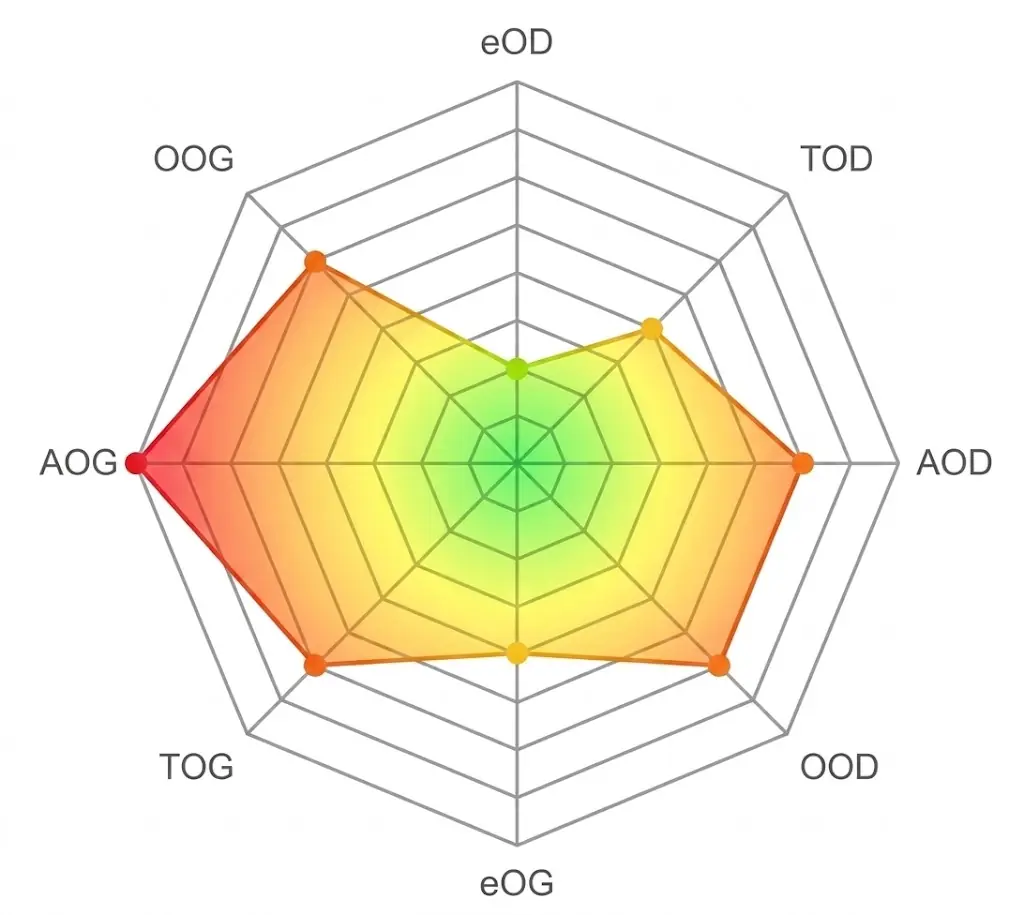
A structured scoring system integrating four clinical axes into a unified severity metric, guiding treatment selection and clinical decision-making.
eTAO Severity Score
The eTAO score integrates four clinical axes into a unified severity metric: corneal epithelium status, telangiectasia severity, meibomian gland atrophy, and gland obstruction. Each axis is graded 1 to 4, producing a composite profile that guides therapeutic decisions.
Normal tear film, no structural changes, no symptoms.
Intermittent symptoms, early tear instability. Environmental triggers.
Persistent symptoms, meibomian gland dysfunction, reduced TBUT.
Significant corneal involvement, marked inflammation, gland atrophy.
Refractory disease, advanced gland loss, multi-modal therapy required.
Clinical Resources
For Ophthalmologists
Access the complete WIDES framework: diagnostic protocols, treatment algorithms, and the eTAO severity scoring system. Clinical tools designed for specialists managing ocular surface disease.
Explore Clinical ResourcesThe Society
An international platform for Interventional Dry Eye
WIDES provides a structured environment for education, research collaboration, and the development of clinical standards in ocular surface disease.
Towards a more structured standard of dry eye care
WIDES exists to bridge the gap between emerging science and everyday clinical practice. Whether you are a seasoned specialist or just beginning to explore interventional dry eye, we provide the framework, the tools, and the community to support your journey.